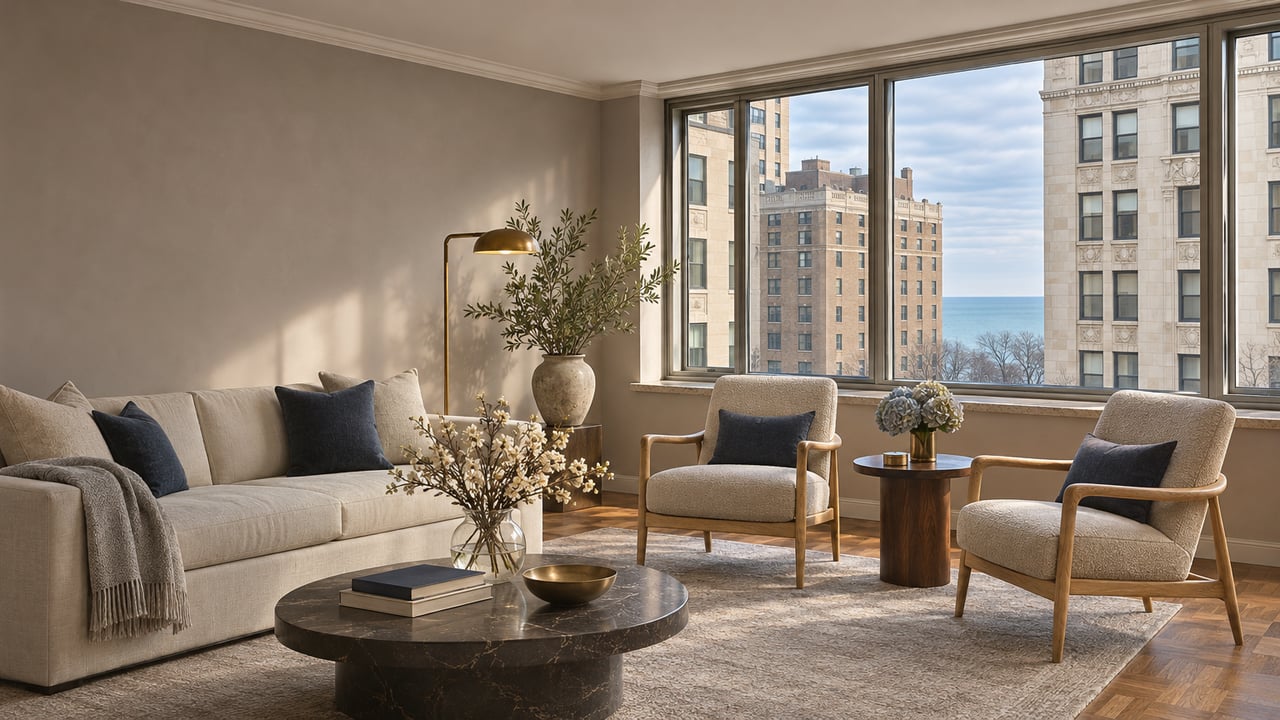
In July, an East Lake Shore Drive condo sold for $5.2 million. Crain's Chicago Business reported that the price was millions of dollars below what the same unit sold for in 2015 and in 2006. In August 2026, the S&P Cotality Case-Shiller condo index for the Chicago metro stood at 212.56. Its earlier high was 160.98 in September 2007, so the index sits about 32% above that peak, according to FRED's table for the series.
The Gold Coast's resale losses are concentrated in a small group of very large units, often in older buildings and often bought near a past high. The rest of the neighborhood has been tightening along with the city. For a buyer comparing the Gold Coast with Lincoln Park or Lakeview, the discount is real, but it belongs to specific buildings and floor plans, and a neighborhood median won't show it.
What the loss stories have in common
The resales that made headlines over the past two years share a profile. On January 7, 2025, a five-bedroom condo of about 8,000 square feet at 65 E. Goethe sold for $6.1 million, roughly 77% of an asking price just under $8 million. The Real Deal reported that the previous owner had spent more than $13.6 million on two purchases in 2013 and 2015 to put together a larger space. In November 2025, another Gold Coast condo sold for $6.4 million, which Crain's Chicago Business described as a $500,000 loss.
The Palmolive Building at 159 E. Walton, built in 1929 at the Michigan Avenue edge of the Gold Coast, has the most detailed record. In its December 2025 rundown of downtown price cuts, The Real Deal listed three Palmolive units:
- A 5,500-square-foot unit first listed at $10.9 million in 2020 was asking just under $6 million. It was bought in 2013 for $6.75 million.
- An 18th-floor unit of nearly 5,000 square feet was asking $4.25 million, a 42% drop from its February 2020 ask of $7.35 million. It was bought in 2007 for $6.3 million.
- A 7,900-square-foot duplex penthouse covering the top two floors had come down from $11.9 million in 2021 to $8.9 million.
The pattern holds just outside the neighborhood. In July 2026, Crain's reported that a full-floor unit at downtown's One Chicago tower, which went under contract at $13.9 million a few years earlier, sold for $5.3 million.
Where the reports give a size, the units run from nearly 5,000 square feet to 8,000, and the One Chicago sale was a full floor. Where they give an earlier price, it was set in 2006 or 2007, or in the years just before 2020. The dollar losses are large mostly because the units are large and the purchase dates came near past highs. The neighborhood is not falling.
Why the largest units behave differently from the rest of the market
For the Palmolive, a downtown condo specialist quoted by The Real Deal said the building lacks the newer amenities luxury buyers want and has seen property taxes rise after recent special assessments. "Today it all comes down to amenities," he said, "and people are more attracted to amenities versus just living in a condo with a doorman."
That fits what other brokers described a few months earlier. In September 2025, an agent quoted by The Real Deal called buyer behavior a "flight to quality," with buyers favoring high-quality units and newer or newly converted buildings. An August 2025 Real Deal report offered two longer-running causes. After the pandemic, work-from-home norms let affluent buyers move to the suburbs and North Side neighborhoods. And downtown had absorbed about 20,000 new condos from the 2000s through the housing crash.
Put together, the market is setting prices by building and by unit type more than by address. A 5,000-square-foot unit in a 1929 building with rising carrying costs competes with every new tower and conversion that has a fitness floor and a pool. Few buyers shop at that size and price, so a handful of listings can sit for years. The Real Deal counted roughly five years on the market for one Palmolive unit. A two-bedroom on a lower floor of a well-run building on the next block has a much larger pool of buyers, and its price follows the citywide market.
The rest of the Gold Coast has been getting harder to buy into
Citywide, that market is still rising. Chicago had 633 condo closings in September 2026, down 5.7% from September 2025. The citywide condo median rose 6.7% over the same period to $375,000, according to Illinois REALTORS®. Across all property types that month, Chicago had 3,788 homes for sale, 20.9% fewer than a year earlier, and the median time on market was 27 days, down from 31. The Chicago REALTORS® October 2026 snapshot shows 2.1 months of supply citywide, compared with 2.5 a year earlier. These are citywide figures. They describe the conditions every Gold Coast seller and buyer works in, though they are not Gold Coast numbers.
Inside the neighborhood, the change started this spring. In an April 2026 report from The Real Deal, agents said listing inventory had fallen for both condos and single-family homes in the Gold Coast, River North and Streeterville. Olivia Stohle of Jameson Sotheby's International Realty said Gold Coast single-family supply fell to 5.5 months in January 2026, from 13.7 months in January 2025. Agents in the same report said that buyers who lost bidding wars in Lincoln Park and Bucktown are turning to downtown.
That spillover is why the Gold Coast belongs on the comparison list of a buyer focused on Lincoln Park. The demand that pushed North Side prices over asking is now reaching the Gold Coast's mid-sized condos and its limited supply of homes. It has not reached the very large units that were still in the price-cut reports last year.
New construction sets the other end of the range
New supply in the neighborhood is coming in small and expensive. Chicago YIMBY reported in July 2026 that 1447 N. Dearborn Street will hold eight three- and four-bedroom condos of 2,500 to 5,500 square feet. Advertised prices run from $2.5 million to $4.9 million, sales were underway, and buildout is expected to take 12 to 18 months after the units sell.
At the top end, those prices show the spread a Gold Coast buyer is working with. A new boutique unit at 1447 N. Dearborn, a vintage East Lake Shore Drive residence and a large Palmolive unit can all fall between $4 million and $6 million. In the past two years they have behaved like three different markets, from a handful of new units with sales underway, to a historic address that still commands millions, to listings that have needed years of price cuts to find a buyer.
Reading a Gold Coast listing this winter
In this market, a buyer needs to know when the seller bought and at what price. That record says more about a seller's room to negotiate than the neighborhood median does. A seller who bought in 2007 is negotiating against that year's price. One of the agents in the December report told The Real Deal that "sellers are definitely taking it on the chin, but at least if they're willing to take it on the chin there are buyers," and that this was not true three or four years ago. The same report noted that some owners who paid heavily before the pandemic were still holding out for a recovery.
The building matters as much as the unit. Its age, its amenities and its recent assessment history all affect resale, and those points come up in the reported explanations for why some buildings have lagged. Unit size works the same way. The deepest discounts in the record are on units of about 5,000 square feet and up, and those discounts have not shown up in smaller units. A buyer who wants one of the Gold Coast's largest units is shopping where sellers have been cutting prices. A buyer who wants a well-kept two- or three-bedroom near Oak Street Beach and the Rush Street restaurants is shopping in a market that tightened through 2026.
A few questions buyers ask about the Gold Coast right now
Does a resale loss mean the building is a bad investment? Not on its own. The reported losses follow purchase timing and unit size closely. A loss on a 2007 purchase mostly reflects how high 2007 prices were. To judge a building, look at its recent sales of units like the one you are considering, its carrying costs and its amenities.
Are Gold Coast condos cheaper than Lincoln Park homes now? They are different products, but the gap between the two markets is narrowing. In The Real Deal's April 2026 reporting, agents said buyers priced out further north were turning downtown, and Gold Coast inventory was falling at the same time. For more on the Gold Coast blocks around these buildings, see our Gold Coast neighborhood page and our look at how Rush Street's restaurant row has changed.
Is new construction the safer choice? Recent buyer demand has favored newer and newly converted buildings. New boutique projects like 1447 N. Dearborn are also priced for that demand, and their delivery dates depend on how quickly the units sell.
If you are weighing a Gold Coast condo and want to know which buildings and floor plans are priced near their real value, Maria Thanasouras can go through recent sales, carrying costs and seller history with you building by building, before you make an offer. You can start with her buyer representation page. If you own on the Gold Coast and want to know where your unit falls in this split, begin with a home valuation. Let's Connect.