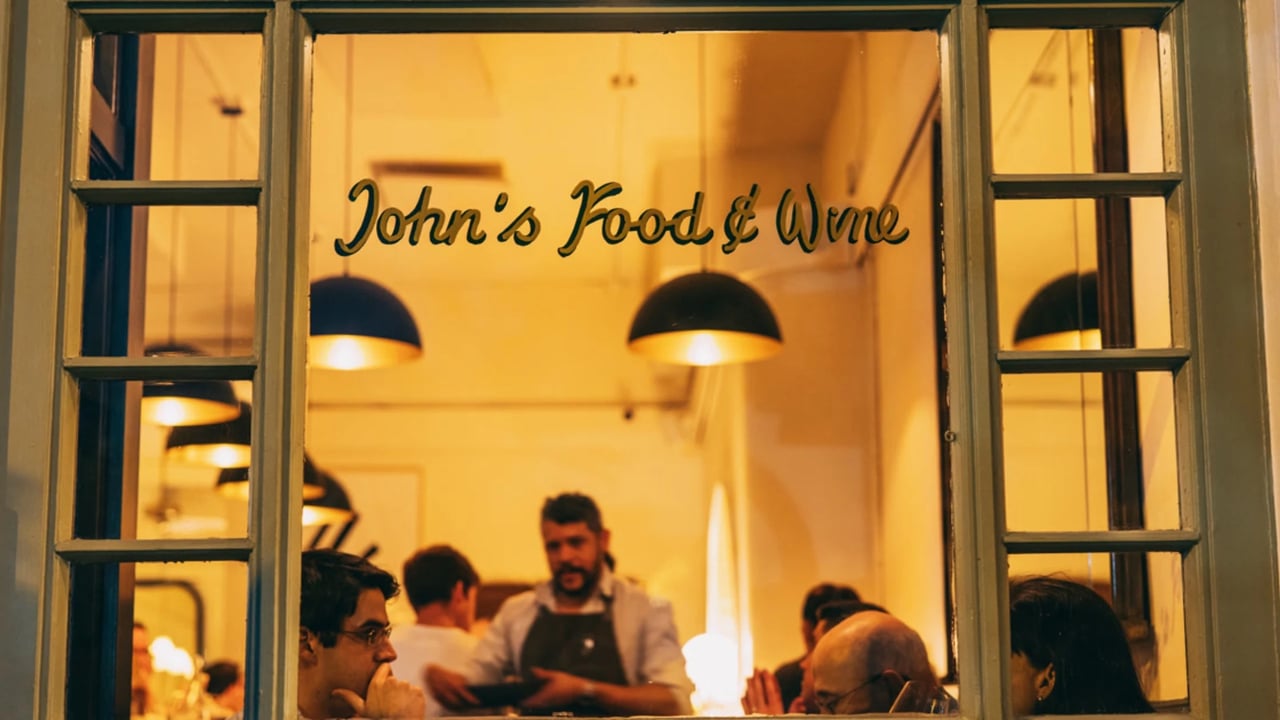
Walk past 2114 N. Halsted St. on a Tuesday night and nothing about the storefront tells you it's holding a national title. No line out front, no neon marquee, just a narrow dining room where two chefs built much of the bar themselves. That's John's Food & Wine, and Time Out Chicago reported that Food & Wine magazine named it the 2026 Restaurant of the Year on September 1, only the fifth restaurant in the award's history to receive that designation, following Diane's Place in Minneapolis, Burdell in Oakland, Birdie's in Austin, and Locust in Nashville.
A block south, at 2020 N. Halsted, a different kind of story just wrapped. Beaumont's, the building dating to 1890, spent nearly three years and hundreds of construction workers becoming a 200-seat tavern with a steakhouse called the Bull Moose tucked upstairs. Both buildings sit on the same street. Both opened within the last two years. Only one of them needed a three-year gut renovation to get there.
That contrast is the actual story here, and it's one none of the roundups covering Lincoln Park's restaurant year have quite named. This isn't a neighborhood where big capital wins every headline. It's a neighborhood where the single biggest validation of the year went to the smallest, least bankrolled entrant on the block.
What Food & Wine Actually Gave the Award For
Chefs Tom Rogers and Adam McFarland met nearly 20 years ago and later worked together under chef Michael Anthony at Gramercy Tavern in New York before returning to Chicago to open John's Food & Wine in 2024, naming it after their fathers. The cooking is why people show up. It isn't why Food & Wine picked this restaurant over every other one in the country.
The magazine's citation centers on the business model. Every guest pays a flat 20 percent hospitality charge, pooled across the front and back of house, and staff earn a minimum of $25 an hour, with room to earn more by taking on added responsibilities. According to Time Out Chicago's reporting, that structure has produced a restaurant where dishwashers can earn roughly $70,000 a year and line cooks around $90,000, figures described in that report as among the highest in Chicago for those roles. The award language calls out restaurants "helping shape the future of American dining through exceptional food, hospitality and impact."
Sit with that for a second. A narrow, no-frills neighborhood bistro on Halsted just became a national reference point for how restaurant staff get paid, not because it has the biggest kitchen or the most capital behind it, but because two chefs decided the math should work differently than it usually does in this business.
The Same Stretch of Halsted Is Building the Opposite Way
Meanwhile, the rest of this Halsted corridor has spent the past year proving the traditional model still works when the operator has already proven it elsewhere.
Beaumont's is the clearest example. The building operated as a 4 a.m. bar for more than 40 years before closing in 2023. Brothers Paul and John Abu-Taleb, who run Pilsen Yards and The Alderman, bought it in 2024 and gutted it down to a shell before rebuilding, opening in late May 2026. In a Block Club Chicago report, Paul Abu-Taleb said the moment he saw the space, "it was the perfect building." Down the block, Dicey's Pizza & Tavern shut its West Town location in early January and reopened at 2435 N. Halsted on February 23, choosing that specific address because it sits directly next to its sister restaurant, Parson's Chicken & Fish, both run by Land and Sea Dept. Between them, at 1733 N. Halsted, Schneider Deli opened its second location on April 1, its first time building a room around the concept instead of borrowing one, after years running out of a diner space attached to a River North motel.
Four of this year's most talked-about Lincoln Park restaurant stories, John's Food & Wine, Beaumont's, Dicey's, and Schneider Deli, sit within a run of roughly seven blocks on the same street. That's not a coincidence worth ignoring. It's a corridor where an award-winning wage experiment and a trio of heavily capitalized, proven-operator builds are running in parallel, on the same sidewalk, at the same time.
Just off Halsted, the pattern holds. Chef Sujan Sarkar, who already had four restaurants running and a Michelin star at his River North spot Indienne, opened Nadu at 2518 N. Lincoln Ave. in April 2025 because he wanted regional Indian food near his own house. Levain Bakery chose 849 W. Armitage for its third Chicago location in November 2025, after testing River North and the West Loop first. Chef Zubair Mohajir opened Muhājir and its attached speakeasy Bobo at 2630 N. Clark St. this July, calling it his most personal project after years building Coach House, Lilac Tiger, and Mirra. Chef John Asbaty's Ox Bar & Hearth, built around a wood-burning hearth inside a 125-year-old space on Clybourn, opened in summer 2025.
Two Different Bets, Same Stretch of Halsted
Here's what that combination actually tells a person who already lives here. This isn't a neighborhood that only rewards big money and proven track records, and it isn't one running purely on scrappy independents either. It's both, on the same handful of blocks, at the same time.
That matters for anyone deciding where to spend a Tuesday night versus a Saturday reservation. The bet on Halsted right now includes:
- A national award going to the restaurant that pays its dishwashers the most, not the one with the biggest build-out
- A 1890 building brought back after a near-total gut renovation, financed by an established Pilsen restaurant family
- A pizza tavern that closed a working West Town location just to sit next door to its sister restaurant
- A deli that waited years to finally get a room built for its own concept instead of a borrowed one
None of those four things happened for the same reason. That's exactly the point. A corridor where a wage-focused two-chef bistro and a three-year renovation involving hundreds of workers can both land national attention in the same twelve months isn't following one playbook. It's proving there's more than one way to make it on this street.
What This Looks Like on an Actual Weeknight
If you're deciding where to eat this week, the practical version of all this is simple. Reservations at John's Food & Wine, open Tuesday through Sunday with hours that stretch into a full weekend brunch, are getting harder to land now that the award is public, so this might be the last easy stretch to get a table this year. A few blocks south, Beaumont's takes walk-ins at its center bar most nights if the dining room is booked, and the Bull Moose upstairs is worth the wait if you want the quieter, dry-aged-beef version of the same building. Dicey's and Parson's together make an easy Halsted double-header on a night you don't want to choose just one thing.
None of these places needed each other to succeed. They just happen to be doing it on the same street, in the same year, for completely different reasons. That's worth knowing next time someone asks what's actually new to eat around here, because the honest answer isn't a list. It's a pattern nobody's pointed out yet: the loudest recognition this neighborhood got all year went to the restaurant that spent the least on its build and the most on its staff.
If you're the kind of person who pays attention to a neighborhood at this level of detail, that instinct tends to carry over into how you think about a home here too. When that day comes, Maria Thanasouras has spent three decades reading Chicago and Milwaukee neighborhoods this closely. Let's Connect whenever you're ready to talk.